

USA Commercial Solar Market Outlook (2026–2036)
America’s commercial solar market offers long-term opportunities across factories, warehouses, offices, shopping centres, agriculture and institutional buildings. Businesses are evaluating rooftop and ground-mounted solar to manage electricity costs, improve energy resilience and advancing sustainability objectives.
Driven by long-term federal tax certainty under the Inflation Reduction Act (IRA), binding corporate net-zero targets, and unprecedented electricity demand from artificial intelligence (AI) data centers and logistics hubs, commercial solar is expected to see steady expansion. While near-term structural bottlenecks—such as grid interconnection backlogs and domestic content supply constraints—present operational hurdles, long-term macroeconomic trends strongly favor distributed commercial generation.
Why commercial customers invest
- Potential savings against grid electricity purchases and exposure to future tariffs.
- More predictable long-term energy planning, subject to site-specific economics.
- Greater resilience when solar is integrated with suitable storage and controls.
- Progress towards corporate energy and emissions objectives.
- As corporate scope 2 emissions undergo scrutiny, companies are turning to on-site commercial solar arrays and corporate Power Purchase Agreements (PPAs) to meet compliance goals.
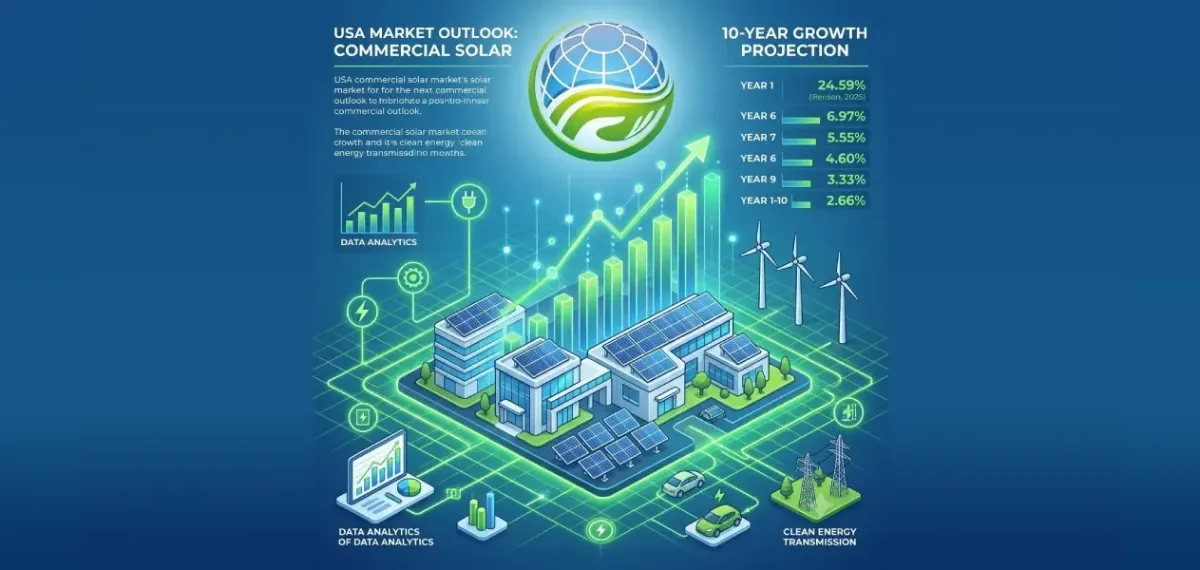
- The overall U.S. solar fleet is projected to nearly triple over the coming decade. The Commercial & Industrial segment will represent a significant portion of this growth, expanding at an estimated compound annual growth rate (CAGR) of 7% to 8% through 2036.
- USA current installed capacity is around 2.3 GWdc (2025) and projected to reach roughly 3.9 GWdc by 2036.
Strategic Recommendations for Green Globe Impex Inc.:
- Target High-Tariff Regions: Prioritize distribution and service capabilities in states experiencing high retail electricity inflation.
- Focus on Integrated Solar-Plus-Storage: Align procurement toward bundled battery storage components, as standalone solar returns diminish under modern utility rate structures.
- Leverage Domestic Content Supply Lines:Ensure supply chain transparency to secure federal domestic content bonus adders for commercial clients.
Priority Markets & Demand Segments
US opportunities vary considerably by state. Local electricity tariffs, incentives, utility rules, permitting and interconnection timelines can matter more than national averages.
| California, Arizona, Nevada | Established distributed solar and storage ecosystem; evaluate self-consumption and export compensation carefully. |
|---|---|
| Texas | Industrial and commercial electricity demand; evaluate utility tariffs, grid conditions and on-site economics. |
| New York & Illinois, New Jersey | Distributed generation and community-solar programmes; project eligibility and local policy are critical. |
| Other industrial states | Manufacturing, logistics and institutional customers offer selective opportunities subject to local economics. |
High-potential Commercial Applications
- Industrial rooftops: manufacturing plants, food processing, cold storage and logistics.
- Retail and institutional: shopping centres, educational campuses and healthcare buildings.
- Solar-plus-storage: peak-demand management, backup capability and energy optimisation.
- Balance-of-system infrastructure: inverters, transformers, electrical panels, cabling and mounting systems.
What will shape demand through 2036?
- Electricity-price trajectories and growing power requirements.
- Federal and state policy, tax-credit qualification and financing conditions.
- Battery storage costs and the value of flexible energy use.
- Product certifications, domestic-content provisions, tariffs and supply-chain traceability.
Policy and Regulatory Landscape
Federal policy is the single largest swing factor for the next five years. The OBBBA accelerated the end of the Section 48E clean electricity investment tax credit for solar and created two distinct paths to eligibility. Treasury and IRS guidance (Notice 2025-42) further narrowed how a project can prove it has begun construction.
Connecting Global Solar Solutions with US Businesses
Green Globe Impex Inc. envisions supporting international commercial relationships in solar-energy products and related electrical infrastructure. Its potential role includes supplier identification, buyer introductions, procurement coordination and cross-border trade facilitation, subject to company approval and applicable laws.
Product Opportunities
| Solar PV Modules & Mounting | Large addressable supply chain; intense competition and trade-compliance requirements. |
|---|---|
| Inverters & Controls | Technical certification, warranty support and grid compatibility are essential. |
| Battery Storage Systems | Relevant to commercial load management and solar integration; safety compliance is critical. |
| Panels, Transformers & Cables | Potential procurement by qualified solar EPC and electrical contractors. |
| EPC Opportunities | International Contractors |
Our Perspective
The next chapter of American commercial solar will be shaped by dependable equipment, transparent sourcing, sound engineering and long-term performance. Green Globe Impex Inc. seeks to connect international capabilities with practical energy opportunities in the United States.
Connect with Green Globe Impex Inc.
Reference Sources For Periodic Updates
Solar Energy Industries Association (SEIA) / Wood Mackenzie — US Solar Market Insight: seia.org/research-resources/solar-market-insight-report US Energy Information Administration (EIA) — Annual Energy Outlook: eia.gov/outlooks/aeo/US Department of Energy — Solar Energy Technologies Office: energy.gov/eere/solar Editorial note: This is an original, qualitative market overview for website use, not an independently audited investment forecast. Verify current policies and company service claims before publication.